Why wet streets look better at night
Every cinematographer knows the trick. The physics behind it was worked out by a lighthouse engineer two hundred years ago.
By Ruth Adeyemi, Science editor · 12 November 2026 · 2 min read
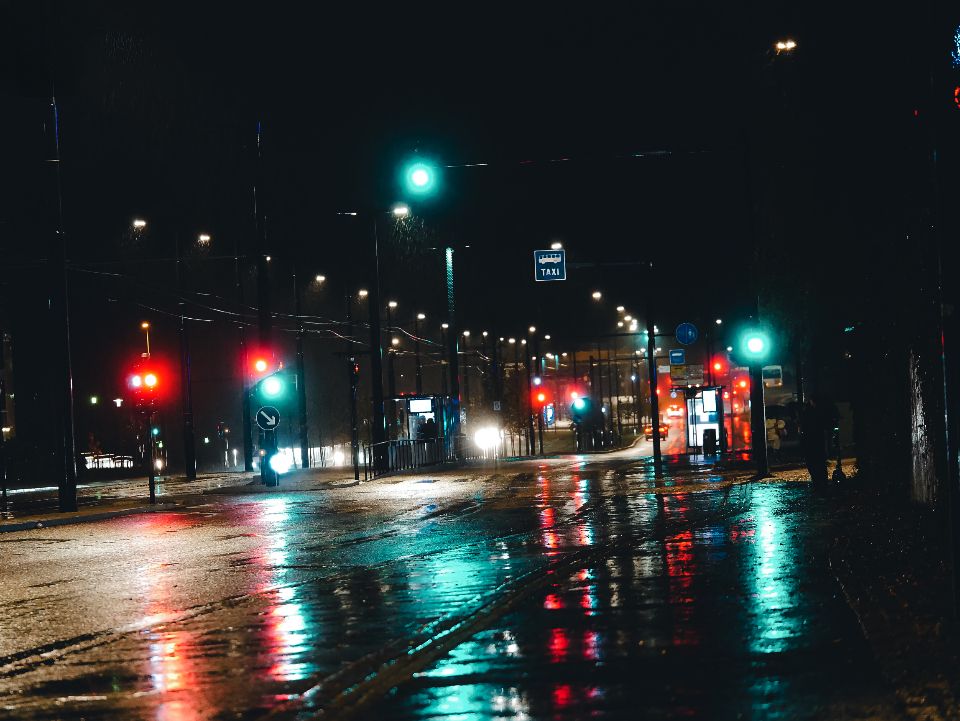
It has stopped raining, but nobody has told the street. Every tail-light on Brunswick Street is now two tail-lights, one on the car and one smeared across the bitumen beneath it, stretched into a long red ribbon that follows you home. Photographers wet down roads before a night shoot for exactly this reason. The question is why it works so well.
A road that turns into a mirror
Dry asphalt is a terrible mirror. Its surface is a jumble of stones and binder at every scale from millimetres down to microns, and light that lands on it scatters in every direction. That is what makes it look matte and grey: you are seeing a little of every light in the street, averaged into mud.
Add a film of water a tenth of a millimetre deep and the surface changes character. Water fills the gaps between the stones and settles into something close to flat. Light now reflects off it the way it reflects off a pond, at the same angle it arrived. Instead of an average of everything, you see one particular light, sharp and bright.
Why the reflections stretch
The reflections are never round. A street lamp becomes a vertical streak, sometimes metres long. That is because the water is not perfectly flat: it ripples, and each ripple tilts the mirror slightly. Seen from a low angle, small tilts along your line of sight move a reflection a long way, while tilts across it barely move it at all. The result is the long vertical smear that every cinematographer from Ridley Scott onward has leaned on.
At grazing angles even a modest surface reflects almost everything. Your street is never shinier than when you are looking along it.
That is the Fresnel effect, named for the French engineer who worked it out in the 1820s while designing lighthouse lenses. Look straight down at a puddle and you see the bottom; look along the street and you see the sky.
The colours were always there
The last ingredient is contrast. On a dry night, the road between the lights is a dull, even grey that flattens everything. On a wet night it goes nearly black wherever there's no light to reflect, so the colours that are there — the green of a pedestrian signal, the sodium orange of an old lamp — sit against darkness instead of grey.
None of this is new. What is new is that we now render it on purpose: game engines and film renderers calculate the same physics for every pixel, which is why the most expensive-looking scene in any trailer is almost always a wet street at night.
Letters
Fetching the letters…